How Many Babies Do Spidermonkey Give During Lifespan
Spider monkeys have long thin limbs and tails: information technology's not hard to meet how these primates got their name! Spider monkeys roam through the rainforest awning in search of fruit and nuts. They are the near intelligent New World monkeys.
Sadly, like many rainforest animals, spider monkeys are under threat – mainly due to habitat loss. This article contains spider monkey facts, and is part of our Rainforest Animals serial. Be certain to watch the video of spider monkeys in the wild!
Read on for in-depth spider monkey information…
Types Of Spider Monkey
In that location are seven species of spider monkey. All vest to the genus Ateles(a genus is a grouping of closely-related animals).
- White-bellied Spider Monkey (Ateles belzebuth)
- Black-faced Black Spider Monkey (Ateles chamek)
- Brown-headed Spider Monkey (Ateles fusciceps)
- Geoffroy's Spider Monkey (Ateles geoffroyi)
- Brown Spider Monkey / Variegated Spider Monkey (Ateles hybridus)
- White-cheeked Spider Monkey (Ateles marginatus)
- Red-faced spider monkey / Guiana Spider Monkey (Ateles paniscus)
All seven species of spider monkey are threatened with extinction, with all but one species (the ruddy-faced spider monkey) beingness either "Endangered" or "Critically Endangered". (The conservation status of the carmine-faced spider monkey is "Vulnerable".)
The spider monkeys belong to the family Atelidae, a family unit of New Earth monkeys that also contains the howler monkeys, woolly monkeys, and woolly spider monkeys. In all, at that place are 29 species in the family unit Atelidae.
Spider monkeys alive in untouched areas of rainforest in Cardinal and South America.
- You can find out more about monkeys on this page: Monkeys: The Ultimate Guide
- You can detect our more about the different types of monkey on this page: Types of Monkey with Pictures and Facts
Spider Monkey Facts: What Do Spider Monkeys Look Like?
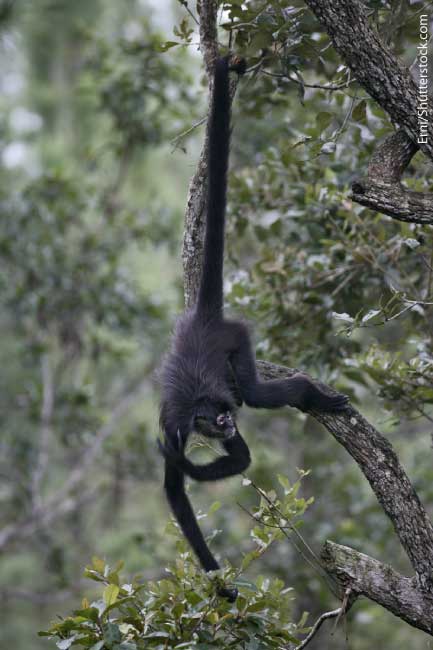
Spider monkeys have long, sparse arms and legs, and a long prehensile tail that tin grab on to branches.
Spider monkeys range in colour from black to brown, red to yellow, and fifty-fifty white.
The largest and most apelike of the monkeys, spider monkeys can weigh as much as 25 pounds (11kg) and accomplish 18 inches (45 cm) in length, not including their amazing tails, which tin grow to 36 inches (90 cm).
Spider monkeys are able to swing mitt over hand through the trees due to their flexible shoulder joints.
The ends of their tails have no pilus; the ridged pare at that place allows them to grasp both branches and food. They are able to use their tails like a fifth arm. This gives them a spider-like appearance, hence their name.
Spider monkeys are great source of entertainment at zoos around the world and are called the 'trapeze artists of the jungle'.
You can see spider monkeys in the wild in the video below:
Spider Monkey Behaviour
Spider monkeys live in communities of xx-40 members, chosen a troop. These diurnal (active during the day) creatures cover about one half-mile of distance each day, spending their fourth dimension eating fruits, nuts, and seeds, every bit well as grooming each other to remove dirt and insects from their fur.
The troop tin can separate into smaller groups during the day to make feeding easier and to ensure the safety of the community. As night approaches, the smaller groups of v-8 monkeys re-join their companions and sleep together in the high canopy of treetops.
Spider Monkey Defense Strategies
When spider monkeys sense predators approaching, they volition make barking sounds to deter them. If that doesn't work, they will shake the branches of the trees with their artillery and legs, while hanging from their tails. They will even break off and drop "twigs" weighing upwards to eight pounds to frighten the intruder away.
Spider Monkey Facts: Family Life
Female spider monkeys give birth to 1 baby every 1-five years. Pregnancy lasts about 7.5 months. When the baby is born, it cannot swing, walk, or take intendance of itself, and so it clings to its mother's breast fur and feeds on her milk.
At near four months, the immature spider monkey begins riding on its female parent'due south back.
Although spider monkeys are able to eat fruit at three months, they continue to exist nursed until they are around two years old.
By historic period four, the spider monkey reaches maturity. Male monkeys volition continue to live in their mother'due south community for the rest of their lives. Nonetheless, females volition leave to detect a new community in which to live, mate, and take babies of their own.
Spider monkeys can live in captivity up to around 35 years. In the wild, they tin can live to effectually 27 years.
Spider Monkey Predators & Threats
Because spider monkeys live and forage loftier in the trees, they have few predators. However, babies have been captured past eagles, owls, and hawks. Also, the lightning fast, tree-climbing jaguar is a real threat, as well as pumas, ocelots, and large snakes such as the anaconda. They can also be carried away past the harpy eagle.
The greatest danger to the spider monkey, however, is humans. Logging and country-immigration are destroying the spider monkeys' habitat.
Are Spider Monkeys Endangered?
As you tin see from the listing below, all 7 species of spider monkey are threatened, with all but one species (the ruby-faced spider monkey) beingness either "Endangered" or "Critically Endangered".
Spider Monkey IUCN Crimson List Classification
- White-bellied Spider Monkey (Ateles belzebuth): Endangered
- Black-faced Black Spider Monkey (Ateles chamek): Endangered
- Dark-brown-headed Spider Monkey (Ateles fusciceps): Critically Endangered
- Geoffroy'south Spider Monkey (Ateles geoffroyi): Endangered
- Brownish Spider Monkey / Variegated Spider Monkey (Ateles hybridus): Critically Endangered
- White-cheeked Spider Monkey (Ateles marginatus): Endangered
- Red-faced spider monkey / Guiana Spider Monkey (Ateles paniscus): Vulnerable
The above data is from the IUCN Carmine Listing.
It is believed that in that location were as many as 400,000 woolly spider monkeys when Europeans first settled in the New World; today, there may only be effectually 400 left.
There are several organisations that have been founded to protect spider monkeys. Monkey World is an ape rescue eye in the Uk. Meet if you tin can discover a similar organisation in your country.
Spider Monkey Facts For Kids
- Spider monkeys exercise not have thumbs, unlike almost monkeys, who have opposable thumbs. Instead, they accept iv, hooked fingers.
- When different troops of spider monkeys meet, they hug each other in greeting, seeking to avoid confrontation. They also wrap their tales around each other as a sign of affection.
- Besides barking, the spider monkey can also whinny like a horse, make sobbing sounds, and scream loud and long.
- Females outnumber males two to one.
- In addition to fruit, basics, and seeds, spider monkeys also eat bird eggs and insects, making them omnivores.
- Spider monkeys can swing through the trees as fast as humans run on the ground.
- They take no hair on their faces, and their hands and feet are black.
- When they walk, their artillery drag on the ground, and they utilise their tails for balance.
- Spider monkeys communicate with nonverbal gestures and postures.
- A spider monkey will e'er sleep in its own, particular tree.
Notice More with Active Wild
We hope that yous have enjoyed reading these spider monkey facts.
You can find out well-nigh other amazing rainforest animals on this page: Rainforest Animals List Page.
Source: https://www.activewild.com/spider-monkey-facts-for-kids/

Post a Comment for "How Many Babies Do Spidermonkey Give During Lifespan"