Who Bulit the National Centre for the Performing Arts
We utilise cookies to ensure we give you the all-time experience on our website. Yous can find out about our cookies and how to disable cookies in our Privacy Policy. If you lot continue to use this website without disabling cookies, nosotros will assume you are happy to receive them. Close.

National Heart for the Performing Arts, Beijing
Contents
- i Introduction
- two Design and structure
- three Costs controversy
- four Notice out more
- 4.1 Related articles on Designing Buildings Wiki
- four.2 External resource
[edit] Introduction
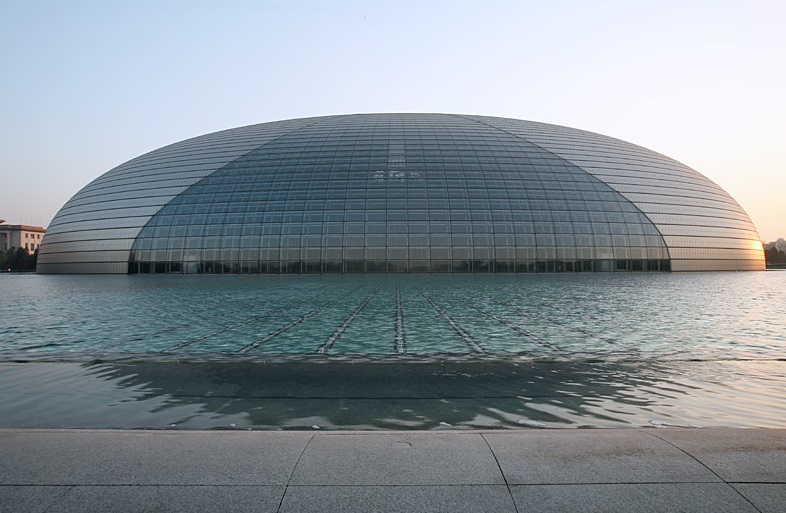
The National Eye for the Performing Arts (NCPA) is located in the centre of Beijing, Cathay. It is known by its nickname 'the behemothic egg', because of its distinctive flattened-dome shape.
The edifice is situated like an island in the eye of an artificial lake of 35,500 sq.thousand. Around the lake a green ring of 39,000 sq.m is intended to isolate the building from the dissonance of the city.
The NCPA was designed by French architect Paul Andreu, and houses an opera house capable of seating 2,398, a concert hall seating 2,019, a theatre seating 1,035, and a smaller multi-role theatre. Structure work began in 2001, and the inaugural concert was held in Dec 2007.
Its location provoked some controversy because of its proximity to Tiananmen Square, the Cracking Hall of the People and the Forbidden City. Andreu argued that, as an important international urban center, Beijing should include modern also equally aboriginal traditional Chinese architecture. The inclusion of the lake and the light-green band were role of the design solution to complement the ancient architecture and prevent the contrast being too jarring.
[edit] Blueprint and construction
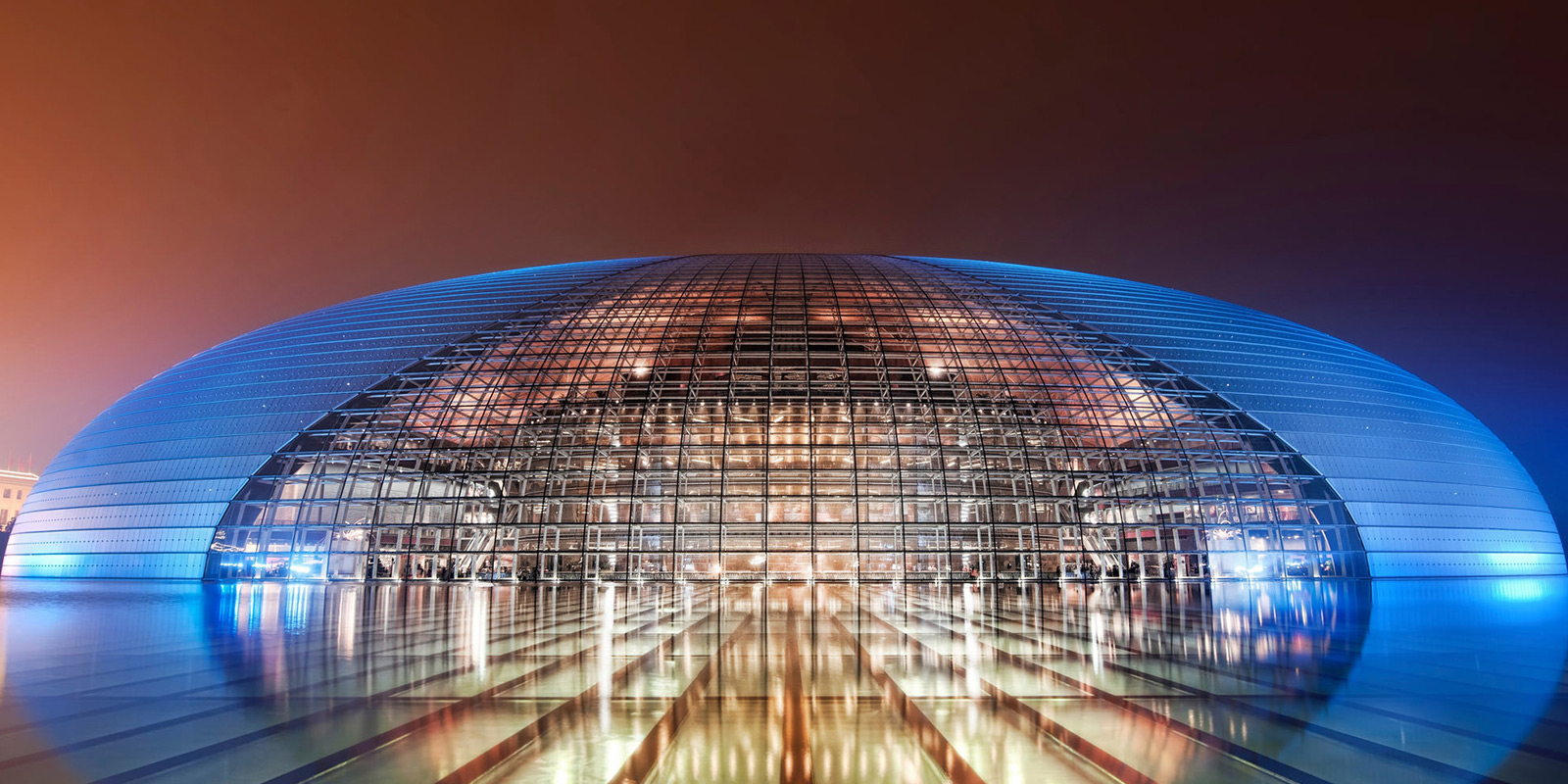
The building is an ellipsoid dome of titanium and glass, designed to resemble an egg floating on water, or a water droplet. Andreu designed the edifice to be an iconic feature that would be instantly recognisable.
The dome has a maximum span of 213 m (in its due east-west direction), a minimum span of 144 k (due north-south), and reaches a tiptop of 46 g. The total area of the building is 12,000 sq.m.
It is covered with eighteen,000 titanium plates, integrated with more than than 1,000 sheets of ultra-white drinking glass; a depression-iron glass with high light transmission. The titanium shell is divided in ii past a curved glass curtain, gradually widening from the acme to the bottom where it measures 100 m in width. When illuminated at night this gives the impression of a stage curtain being pulled back, while during the twenty-four hours the glass curtain bathes the interior in light.
Visitors reach the building through the Underwater Corridor, a hallway that stretches beneath the lake from the green ring. The glass ceiling allows light to pass through from the h2o, producing a shimmering event.
The large open foyer has a floor made of rock from 10 dissimilar regions in Prc. The interior walls are lined with tens of thousands of panels made of Brazilian rosewood.
[edit] Costs controversy
The building'southward initial planned toll was 2.688 bn yuan. However, on completion, this had escalated to more than iii.2 bn yuan. It has been suggested it will be shut-to impossible to recuperate the investment. Each individual seat, when averaged out, is worth around 500,000 yuan. On top of this, the huge costs of cleaning the external surface hateful that the Chinese government faces subsidising the building for many years. Responding to this though, the Chinese government claimed that the building was never intended to be a for-profit venture.
[edit] Detect out more
[edit] Related articles on Designing Buildings Wiki
- Apple Park.
- Beijing Greenland Centre.
- Beijing National Stadium.
- Building of the week serial.
- CCTV Headquarters.
- China Philharmonic Hall.
- Urban center Hall, London.
- Forbidden City.
- Guggenheim Museum, Bilbao.
- Niteroi Contemporary Fine art Museum.
- Phoenix International Media Center, Beijing.
- Rose Museum.
- Regal Albert Hall.
- Sage Gateshead.
- Sydney Opera Business firm.
- Types of dome.
- Unusual edifice pattern of the calendar week.
- Xili Sports and Cultural Centre.
[edit] External resource
- Arcspace - National Centre for the Performing Arts
Source: https://www.designingbuildings.co.uk/wiki/National_Centre_for_the_Performing_Arts,_Beijing

Post a Comment for "Who Bulit the National Centre for the Performing Arts"